

Only connect
What have your family stories taught you? And what are you choosing to keep?

Howards End begins with the epigraph:
Only connect.
I first read this in college. As a young woman, I was drawn to this story of people reaching for one another across the distance of class, expectation, and fear, and and to the idea that connection itself was a kind of lifeforce.
I see that as my work in the world now. To recognize it. To build it. To protect it.
I am visibly connected to the soil, the trees, the flowers, the birds, even to the mountain lion who moves through this land. I’m not separate from any of it. But I am also connected to what I can’t see, to what lives underneath. To what feeds me, and what holds me, to the stories I’ve been told, and the stories I tell.
Unlike many girls in this country, I didn’t grow up with princess stories. My stories were older, dustier, braided from the words of the Old Testament, as delivered in the language of King James. My maternal grandmother, Ruth, read to me from Proverbs 31, and interpreted out loud what makes a good woman in this world.
Ruth planted her own life, again and again, with the fruit of her hands, playing music, teaching music, earning the money to feed her family while her husband waved his hands around and chanted versus from the Bible. She showed me what it looks like to put your hands in the dirt, to build something that lasts.
Who can find a virtuous woman, for her price is far above rubies.
Grandma tilted her head at that, explaining that virtuous originally meant strength, valor, a kind of internal steel, forged under pressure. Rubies aren’t soft, she would tell me, they are created in fire.
She herself had always lived at the hard edges of culture, a Quaker woman with her own mind and her own silence, who gave up her traditions to follow her husband and support his patriarchal version of prophecy. But when he wasn’t around, she would quote lines from this chapter like she was giving me tools: a hammer, a seed packet, a map folded so many times the creases threatened to split.
Grandma didn’t talk much about her own childhood, but I understood that she was giving me this definition of a good woman as a mirror, not a cage. She knew our family’s limitations, and she knew I would have to make my own way in the world.
She considereth a field, and buyeth it: with the fruit of her hands she planteth a vineyard.
The version of womanhood I learned from Grandma’s recitations wasn’t a princess who needs rescuing, or a helpmate to a man. It was a story of someone who evaluates fields and decides, yes, this one, this soil will feed my future. It was a tribute to somone with economic power, who knew how to buy land.
The good woman in this chapter is a leader. Not metaphorically. Literally. Pastors seldom mention this definition.
She girdeth her loins with strength, and strengtheneth her arms.
This woman is a worker preparing for physical labor, strengthening her arms, preparing to lift something heavy.
She perceiveth that her merchandise is good.
This is a woman who trusts her work, her intuition, her worth, not because someone praises her, but because she knows what she has made and what it cost her.
She stretcheth out her hand to the poor; yea, she reacheth forth her hands to the needy. Strength doesn’t isolate her, it ripples outward. She knows scarcity and hunger, so she opens her hand, not from abundance but from compassion.
Strength and honour are her clothing; and she shall rejoice in time to come. She is wearing her own endurance, dressed in what she has survived. And because she has made her own world, she can rejoice in what is coming next. This line feels like a blessing spoken straight into the chest.
She openeth her mouth with wisdom; and in her tongue is the law of kindness. She is discerning with her words, sharp when she needs to be, soft when she chooses to be. Her voice isn’t ornamental, it’s guiding.
She looketh well to the ways of her household, and eateth not the bread of idleness. Give her of the fruit of her hands; and let her own works praise her in the gates.
My grandmother’s silence taught me almost as much as her speech. Her works praised her. What she made with her own hands became her testimony.
Ruth used the Bible to teach me how to survive in a man’s world, how to buy land, how to build a home, how to plant vineyards in hostile soil, and how to read a field and call it mine.
What have your family stories taught you? And what are you choosing to keep?
A gift for you:
Forager Field Note #10 - All We Need
And, while you’re on Spotify, consider giving Forager: Field Notes for Surviving a Family Cult a listen, free for those on Spotify Premium.
ONLINE WORKSHOPS - THE SECRET GARDEN SERIES
The Art of Storytelling
Saturday, June 27 - 1:00-2:00 PT
In this hands-on workshop, you’ll learn how to tell a vivid, emotionally resonant story you can use anywhere: in your writing, your career, your relationships, for an ice breaker, a wedding toast, a comedy sketch.
If you want to deepen connection, with yourself, or with others, learn to tell stories.
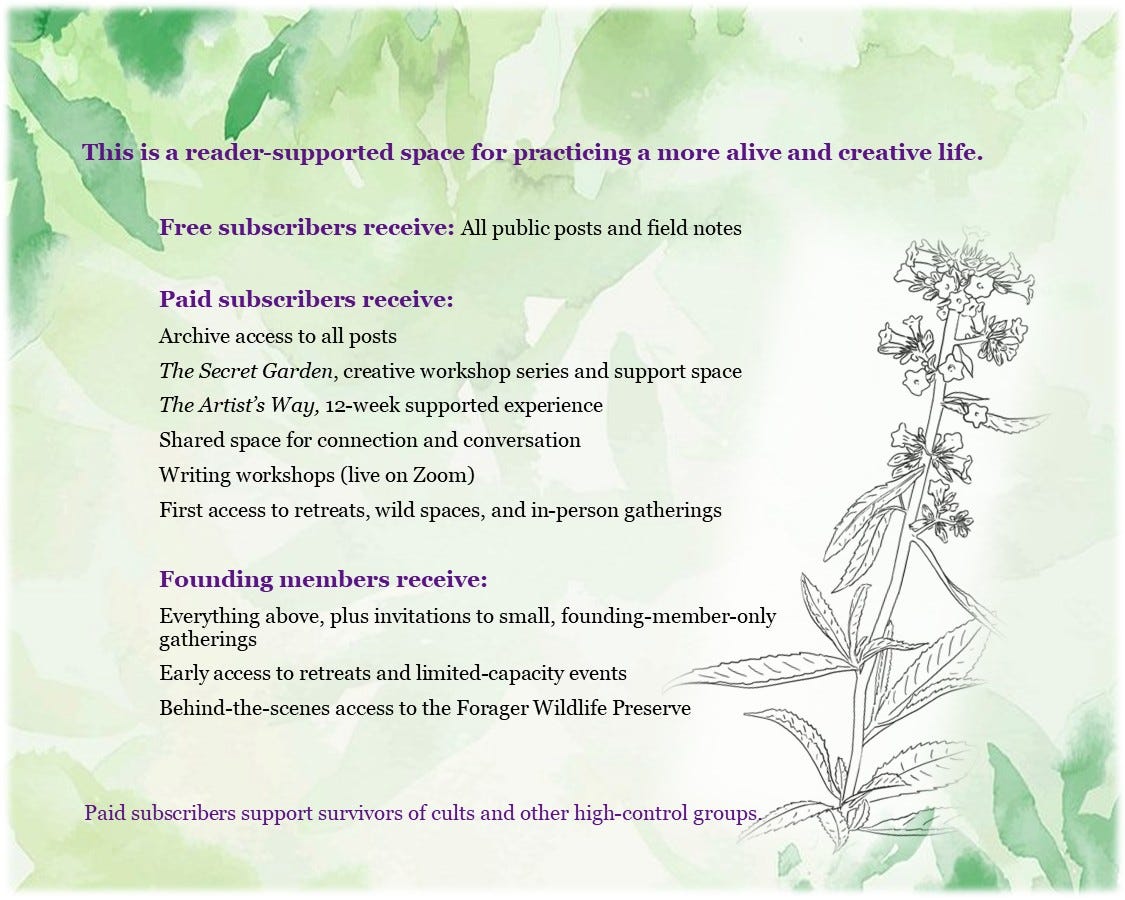
The Secret Garden Series is an 8 week exploration of your chosen art practice, with written check-ins weekly. The series opens with a storytelling workshop and continues through the summer with monthly workshops and weekly prompts.
Wander in and out of this garden, as little or as much as you like.
Workshops are offered on the following Saturdays from 1:00-2:00 PT
June 27 - The Art of Storytelling
July 25 - Art as a Daily Practice
Aug 29 - The Art of Mindfulness
$49 for all 3 workshops (via Venmo)
(OR, free with your annual paid subscription to Forager Field Notes)
All recordings will be available.
More ways to connect
Summer Solstice Retreat
June 18–21 - We’ll gather at the longest light of the year to write, walk, hike, dance, and celebrate together. ONE SPOT left for a private room. ONE SPOT left for a shared room. If you’d like more information, or want me to hold a place for you, send a note to me at booking@michelledowd.org
In-Person - Yoga at the Maloof - Rancho Cucamonga – Fridays at 10 a.m. Yoga on Tap at Claremont Craft Ales – 2nd & 4th Sundays, 11:30–12:30
Who Am I?
I’m a writer, teacher, and lifelong forager, raised in an apocalyptic cult in the mountains of California, where I learned to survive off the land and listen for what lives beneath the surface.
My memoir, Forager: Field Notes on Surviving a Family Cult, tells the story of how I left everyone and everything I believed in, and why. Now, through this newsletter, along with retreats and workshops, I help others build creative lives rooted in attention, embodiment, and relationship with the natural world.
Your parents sound like they were on the same page as each other. That’s helpful. And yes, you probably should!!!!
I was taught there were angels and demons all around me.
I was terrified of the demons.
I no longer hold to the stories of demons. But I am opening again to the possibility of angel spirits surrounding.