

I lost my temper.
Thoughts on anger, intimacy, and learning to move with what we feel.

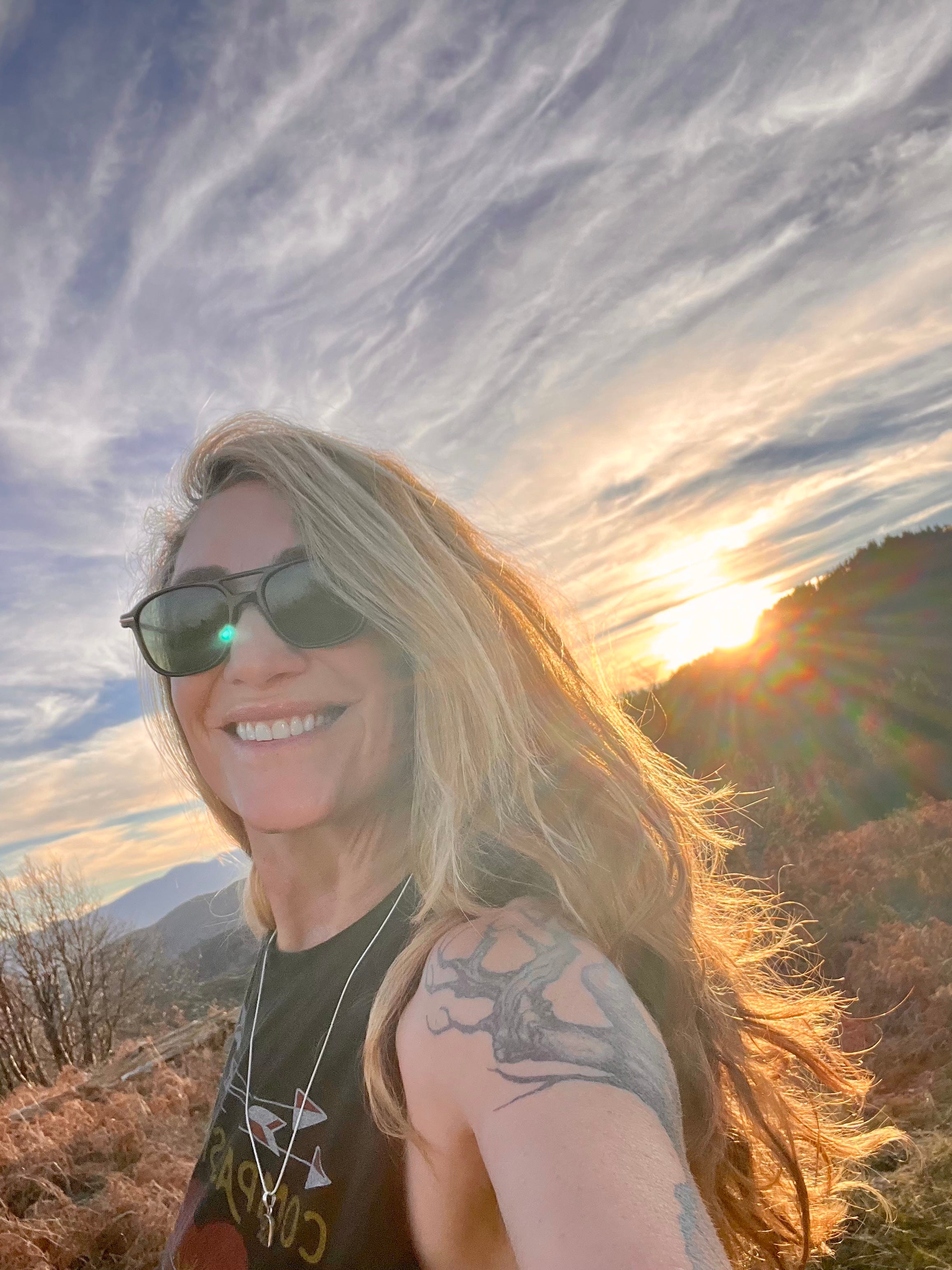
This week, I got unexpectedly angry with someone I love. It was a relief to speak the words that had been shadowing me, but still, I felt shame afterward for losing my temper and speaking dramatically, without control.
Afterward, I sat under an oak tree and looked up at the sky, judging myself. Wispy clouds shifted above me, thinning and reforming, and as the breeze picked up, my breath and heartbeat softened. A leaf landed on my lap.
And I was reminded that every moment, the earth changes. Everything in nature is connected, and as one thing shifts, the ripple expands. The wind moves through the canopy and the canopy answers. Light changes, and everything beneath it adjusts.
I am not the girl I was.
I am not the girl who suffered in silence, who held her breath and became small, who sometimes hurt herself to keep from talking back. The open communication I want to build in my close relationships now requires me to show up as I am, to stay present, even when I don’t feel in control. It asks me to trust that truth, spoken imperfectly, is still a form of care.
And that takes practice.
Because there is a part of me that still reaches for armor. That wants to retreat, to smooth things over, to disappear before I can be seen too clearly. There is a part of me that still believes love is safest when I am contained.
But something else is growing.
Sitting there, I watched the branches of the oak tree move in the wind, responding with gentle sways, each group of leaves shifting in relation to the others. No resistance to the wind. Just relationship.
And I began to wonder if my anger is not a failure, but a signal. Not something to suppress, but something to listen to more carefully, a boundary coming into form.
I placed my hand over my chest and felt the echo of what had moved through me. Not just the sharpness of the anger, but what lives beneath it. A need to be heard. A desire to be met. A quiet insistence: this matters.
As a woman, I’ve been taught to fear my intensity. To soften it, to contain it, to translate it into something more palatable. But the same force that rises as anger can also become clarity. Direction. Movement.
What if nothing in us is wasted?
What if even our most uncomfortable emotions are part of the ecosystem of who we are, like wind or weather, asking us to pay attention?
Before I got up, I let myself stay a little longer and tried something simple. I named, quietly, what I was feeling in my body. Not just the anger, but what was underneath. I let the words come without correcting them. I let them land. I let them move. And then I pulled out my journal and wrote them down.
If you want to try this with me, you might step outside, or sit near a window. Take a few deep breaths. Notice what is moving, inside you, and around you. Then, without judgment, begin to name what is there.
Don’t try to fix it or resolve it. Just listen. Notice. Name. Then pick up a pen and write down the words. No judgment. Just observing what is.
Because every moment, something is shifting.
And we are allowed to shift with it.
I have a little gift for you:
Forager Field Note #5 - Adventure Awaits
And, while you’re on Spotify, consider giving Forager: Field Notes for Surviving a Family Cult a listen, free for those with a Spotify account. Thank you. It means something to me.
More ways to connect
Online — Alternative Artist’s Way Cohort
Begins June 27, 2026
(No book, no religion, no “tasks.” Just curiosity, pleasure, and play.)
The Art of Storytelling
Saturday, April 25 - 10:30-2:00
Telling stories brings people together. Reading, viewing or listening, you can learn to craft stories with emotional truth and resonance. Whether you’re developing a professional voice, writing in your journal, composing letters to friends, animating campfire stories or giving a toast, this workshop will help you build scenes your audience won’t forget. REGISTER HERE
Summer Solstice Retreat
June 18–21 - We’ll gather at the longest light of the year to write, walk, hike, dance, and celebrate together. If you’d like more information, or want me to hold a place for you, send an email to booking@michelledowd.org
In-Person - Yoga at the Maloof - Rancho Cucamonga – Fridays at 10 a.m. Yoga on Tap at Claremont Craft Ales – 2nd & 4th Sundays, 11:30–12:30
The Artist’s Way – Recovering a Sense of Autonomy
There comes a point in creative recovery where the question is no longer can I create? but am I allowed to live this way?
Many of us learned early that our choices were not entirely our own. We adapted to expectations, to systems, to relationships that asked us to shape ourselves in ways that ensured belonging. We became perceptive, capable, responsible. We learned how to read a room, how to anticipate needs, how to make ourselves acceptable.
These are not failures. They are intelligent responses to a place and time.
But these adaptations can harden into a life that no longer feels like ours. We begin to feel the quiet tension between what we are doing and what we want to be doing.
Autonomy is the willingness to listen to that tension. It asks: What do I want, when I am not trying to please, perform, or protect? Can I trust what I desire?
And then, more challengingly: What small step am I willing to take in that direction?
This week invites us to notice where we are still negotiating with our own lives. Where we override a desire before it has time to fully form. Where we ask permission internally before making a move. Where we stay in patterns that are functional, even successful, but no longer alive.
Autonomy begins quietly, with a decision to spend an hour differently, or a willingness to disappoint others.
For many of us, autonomy is entangled with fear.
If I choose differently, will I lose connection? If I follow this instinct, will I be seen as selfish? If I step out of line, will I still belong?
These are real questions, and they deserve respect. But they are not the only questions.
There is also: What might become possible if I trusted myself?
Creative autonomy is about self-trust. And the capacity to make choices that align with our inner lives, even when we are not immediately validated by the outer world.
And like all forms of trust, it is built through repetition.
You keep a promise to yourself. You follow a curiosity. You honor a boundary. You return to the page.
Over time, something shifts. You begin to recognize your own voice as a reliable guide. You begin to feel less divided. You begin to experience your life as something you are inhabiting.
Autonomy requires alignment. Which grows, slowly and steadily, every time we choose to listen.
This Week’s Questions
Take these slowly. Let them open, rather than close.
Where in my life do I feel most like myself right now? Where do I feel least like myself?
What choices am I making out of habit, expectation, or fear rather than desire?
Where am I still asking for permission, externally or internally, before allowing myself to act?
What is one small decision I could make this week that would feel more aligned with who I am becoming?
What am I afraid might happen if I trusted my own timing, instincts, or direction?
Where have I already begun to reclaim my autonomy, even in subtle ways?
How did your morning pages feel this week? Did you notice any shifts in honesty, clarity, or self-trust as you wrote?
What did you choose for your artist’s date? Did it feel like something you genuinely wanted, or something you thought you should do?
Final Zoom meeting for this cohort
Saturday, April 4 at 1:00 PM (PT)
We’ll share our feelings about this journey we’ve been on together, and then practice some somatic tools for sustaining our creative lives.
Who Am I?
I’m a writer, teacher, and lifelong forager.
I was raised in an apocalyptic cult in the mountains of California, where I learned to survive off the land and listen for what lives beneath the surface.
My memoir, Forager: Field Notes on Surviving a Family Cult, tells the story of leaving everything I knew.
Now, through this newsletter, along with retreats and workshops, I help others build creative lives rooted in attention, embodiment, and relationship with the natural world.
Michelle, I really needed to read your message today. A few nights ago, I dreamt I was a dragon, swimming in a pool with other dragons - including one that was sleeping at the bottom of the pool. Someone aroused the sleeping dragon, and it became enraged. I'd never seen such wrath. I was afraid of the dragon, tried to escape. And when I awoke, it occurred to me that the sleeping dragon symbolized my own latent rage. Right now, it seems I'm afraid of it. But maybe it wants to teach me something. And that felt confirmed by your essay today. Thank you for sharing your gift.
"For those who love, everything is clear. For those who do not, what can be done?"