

You are the medicine.
And you can tend to what ails you.

Some questions don’t have answers. Some griefs don’t go away. And some losses don’t return what they took. I’ve spent years trying to understand what to do with these truths.
In the Irish language, the word muin means to teach, but it also means to learn. The root holds both at once. My ancestors practiced learning in a circle, literally and figuratively, because teaching and learning are indivisible. I’ve been thinking about that a lot lately. I left my career in professional teaching largely because academia presents a teacher as an expert who delivers content to students, and something in that model began to feel severed from the way I understand learning to actually happen.
My teacher has arrived in the form of a wildlife preserve, with a tiny cottage and front row seats to sunrises and sunsets, the accompanying wind in the trees blowing my hair with the scent of bark, sap and sage.
Yesterday, I laced up my boots on a rock, ready to make field notes on trees, birds, and the stages of ripening of edible plants within hiking distance. I stretched my legs and stepped into the trees before the sun crested the ridge. No map, no app, just instinct and the pull of something older.
As a child, I imbibed my mother’s stories, as my mother imbibed them from her father. As an adolescent, these stories became my own, and if I had not left the Field, I would now be reciting the same tales to my grandchildren without a qualm. My mother taught me to believe in a God who demanded all, who dangled us like a spider on a thin web over a fiery pit, who parceled out justice arbitrarily, who killed first-borns and hardened Pharaoh’s heart.
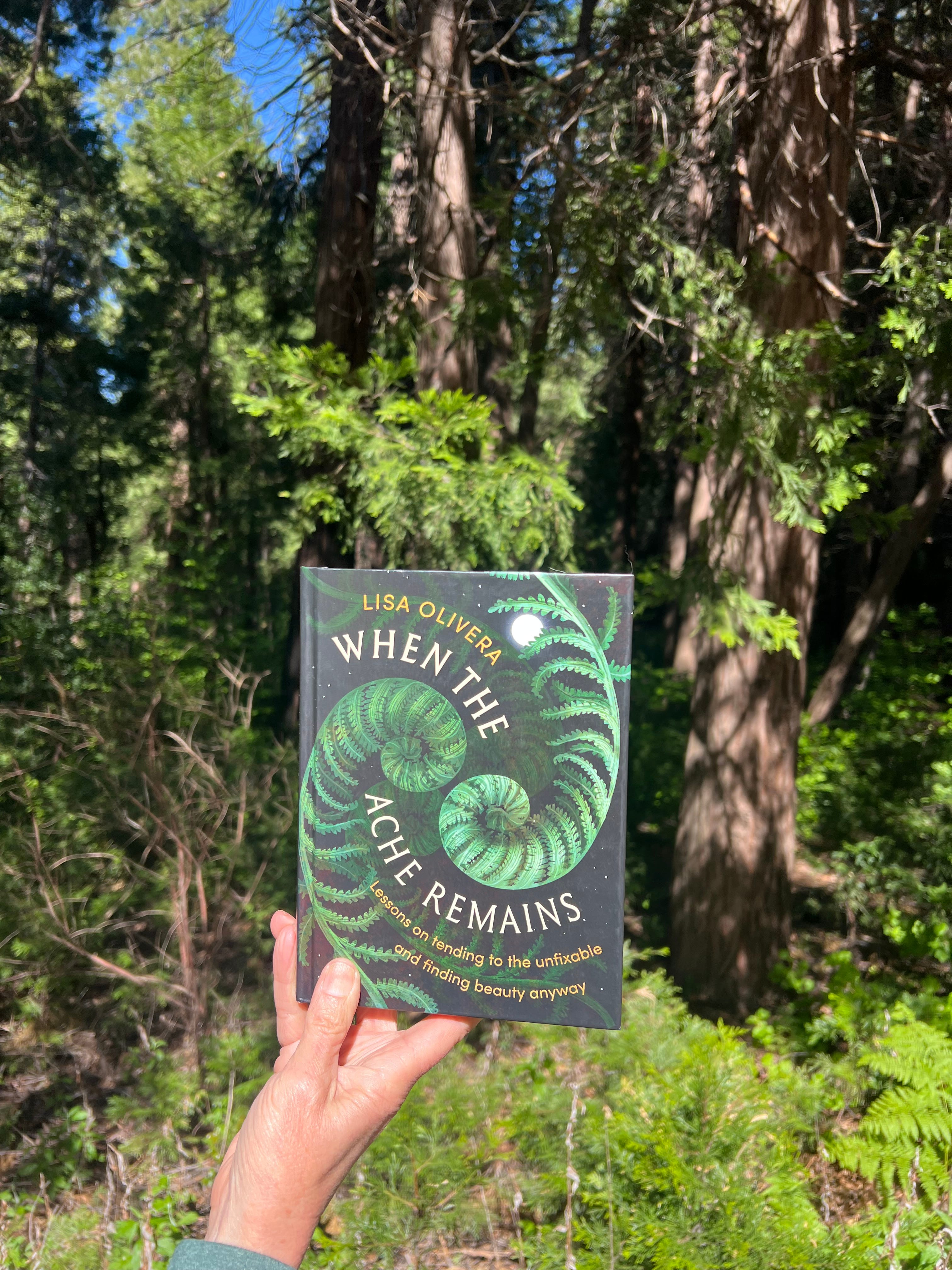
Lisa Olivera’s new book, When the Ache Remains, looks at how we come into relationship with aches that don’t leave, and the ones that return, even after we’ve named them, understood them, and worked on them. This, as many of you know, is something I keep circling back to in my own life and work.
Reading this book feels like being reminded of something I already know but forget when I’m hurting: that I don’t need to outrun my memories to be okay. I can turn toward them and tend to my body.
Lisa, who also writes Human Stuff here on Substack, has been exploring this space for many years, with a kind of steadiness I trust. She doesn’t promise resolution or package pain into something neat. Instead, she offers a way of relating to the parts of ourselves that don’t transform on a timeline.
We circle back, grieve again, and meet ourselves, over and over, in new seasons, with old stories still alive in our bodies. This the work of being human.
Lisa explains María Sabina’s phrase you are the medicine. Because if we are the medicine, then we don’t get to abandon ourselves when things hurt. We don’t get to bypass our aches in search of something shinier, easier, or more resolved. We don’t get to leave when things gets uncomfortable.
Lisa reminds us that the ache is not a problem to solve, but a place to listen.
If you find yourself in a place that won’t be fixed, I encourage you to experiment with some of the ways Lisa encourages us to reach for our own medicine.
1. Name the ache without trying to solve it
Sit with it. As sensation.
Where does it live in your body? What does it feel like? Heat, pressure, hollowness?
Then ask: What do you need me to know?
2. Build a physical “medicine bag”
Not metaphorically. Literally.
Gather a few small objects that ground you: something from the land, something textured, something that carries memory or meaning.
When you’re overwhelmed, reach for it.
Let your body remember: you already have tools.
3. Welcome the fallow
We are trained to produce, to emerge, to become.
But there are seasons that are not for blooming.
If something in your life has gone quiet, creatively, relationally, emotionally, resist the urge to force growth.
Fallow is not failure. It’s restoration.
4. Ask the natural world for perspective
Go outside, even briefly.
Watch what is actually happening around you, not what you project onto it.
Light shifting. Wind moving. Birds landing and leaving.
Let yourself be one small part of a much larger process.
Connection doesn’t erase pain. But it changes its scale.
5. Make something with your hands
Cook something slowly: stand at the stove, stir, taste, adjust, let your senses lead.
Draw without meaning, marks, loops, lines, just to see what appears.
Tend a small space, your table, your bed, a patch of ground, and move things until they feel right in your body.
Plant something that wants to grow. Feel the soil under your nails, bark against your palm, water over your hands.
Creation, at its most basic, is a conversation between you and the world.
6. Let yourself receive
This one is harder than it sounds.
Notice where you deflect care. Where you minimize your needs. Where you insist on being the one who holds everything.
Then practice the opposite, in small ways.
Let someone show up. Let yourself soften.
An open heart doesn’t need closing. This is a radical idea when you’ve spent years learning how to protect yourself by narrowing, tightening, controlling the aperture of your feeling.
But what if the work is to stay open long enough to hear what the ache is asking for?
Tending to myself is not a one-time decision. It’s a practice of returning, and a willingness to sit beside the parts of me I used to try to outgrow.
Some things in life are unfixable. But that doesn’t mean we are helpless.
It means we are being asked into a different kind of relationship, with our pain, with our bodies, with the quiet intelligence that lives underneath everything we’ve been taught to override.
You are the medicine.
And an open heart, no matter how much it has held, does not need closing.
A gift for you:
Forager Field Note #10 - All We Need
And, while you’re on Spotify, consider giving Forager: Field Notes for Surviving a Family Cult a listen, free for those on Spotify Premium.
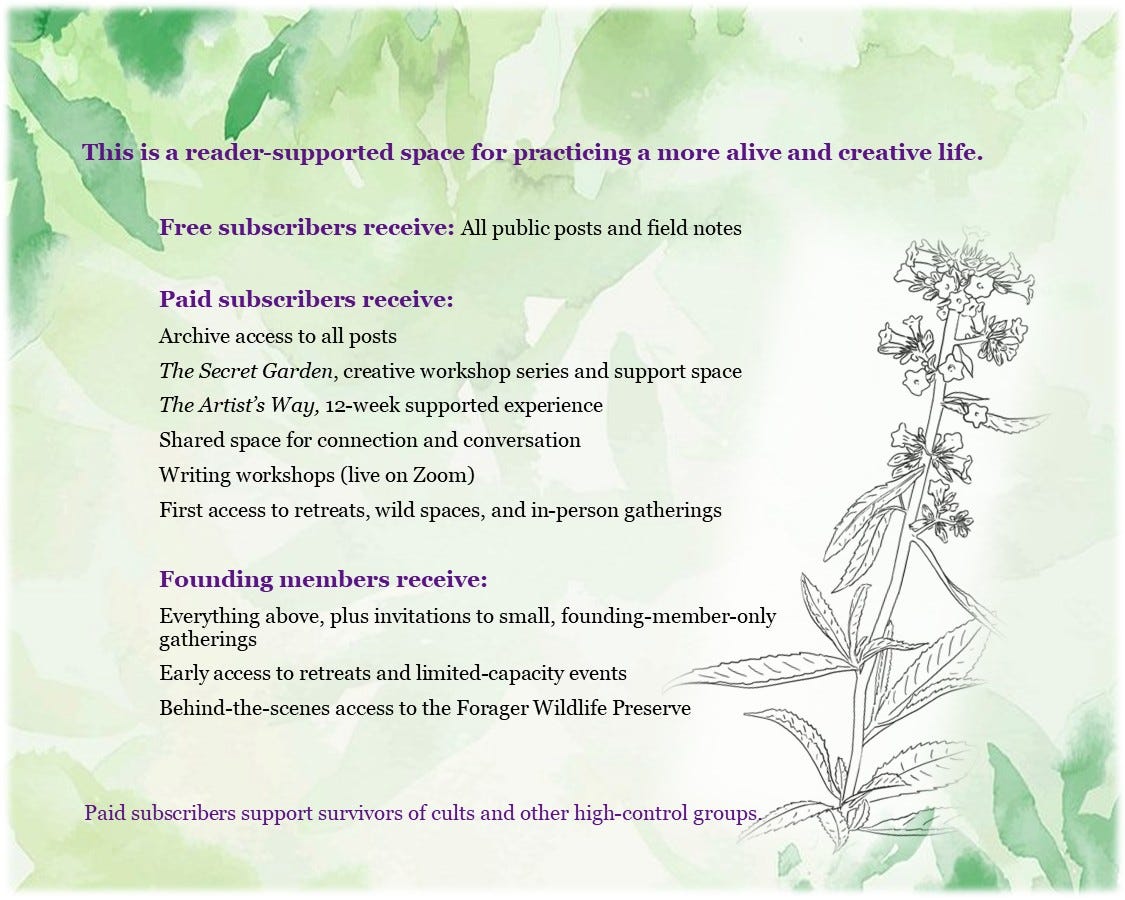
ONLINE WORKSHOPS - THE SECRET GARDEN SERIES
The Art of Storytelling
Saturday, June 27 - 1:00-2:00 PT
In this hands-on workshop, you’ll learn how to tell a vivid, emotionally resonant story you can use anywhere: in your writing, your career, your relationships, for an ice breaker, a wedding toast, a comedy sketch.
If you want to deepen connection, with yourself, or with others, learn to tell stories.
The Secret Garden Series is an 8 week exploration of your chosen art practice, with written check-ins weekly. Series opens with a storytelling workshop and continues through the summer with monthly workshops and weekly prompts.
Wander in and out of this garden, as little or as much as you like.
Workshops are offered on the following Saturdays from 1:00-2:00 PT
June 27 - The Art of Storytelling
July 25 - Art as a Daily Practice
Aug 29 - The Art of Mindfulness
$49 for all 3 workshops (included in your annual paid subscription)
All recordings available for subscribers who can’t attend live.
Register here:
Current annual subscribers - sign up by commenting The Secret Garden on this post.
More ways to connect
Summer Solstice Retreat
June 18–21 - We’ll gather at the longest light of the year to write, walk, hike, dance, and celebrate together. ONE SPOT left for a private room. ONE SPOT left for a shared room. If you’d like more information, or want me to hold a place for you, send a note to me at booking@michelledowd.org
In-Person - Yoga at the Maloof - Rancho Cucamonga – Fridays at 10 a.m. Yoga on Tap at Claremont Craft Ales – 2nd & 4th Sundays, 11:30–12:30
Who Am I?
I’m a writer, teacher, and lifelong forager, raised in an apocalyptic cult in the mountains of California, where I learned to survive off the land and listen for what lives beneath the surface.
My memoir, Forager: Field Notes on Surviving a Family Cult, tells the story of how I left everyone and everything I believed in, and why. Now, through this newsletter, along with retreats and workshops, I help others build creative lives rooted in attention, embodiment, and relationship with the natural world.
Notice where you deflect care.
Thank you for the how-to. And that book cover is killer. I'm so glad you've told us about it. I'm going to find it.